Software-Defined Aircraft · Patented

1,000 km Range. Around US$70,000. Four-Seat VTOL. Lambda.

The World's First Asynchronous Tiltrotor
Architecture.

8Independent Tilting Propulsors
4Aircraft Classes
475 kg / 4 SeatsCargo / Crewed
All Flight ModesDeterministic Control

Deterministic Flight. Faster Certification. Lower Cost.

2026.1025 kg-Class Aircraft Flight Test

It will make everyone wonder: Why wasn't this done sooner?

Conventional eVTOL aircraft are becoming increasingly complex. More actuators mean more software, longer certification schedules, and higher manufacturing costs.

The world's simplest tiltrotor aircraft.
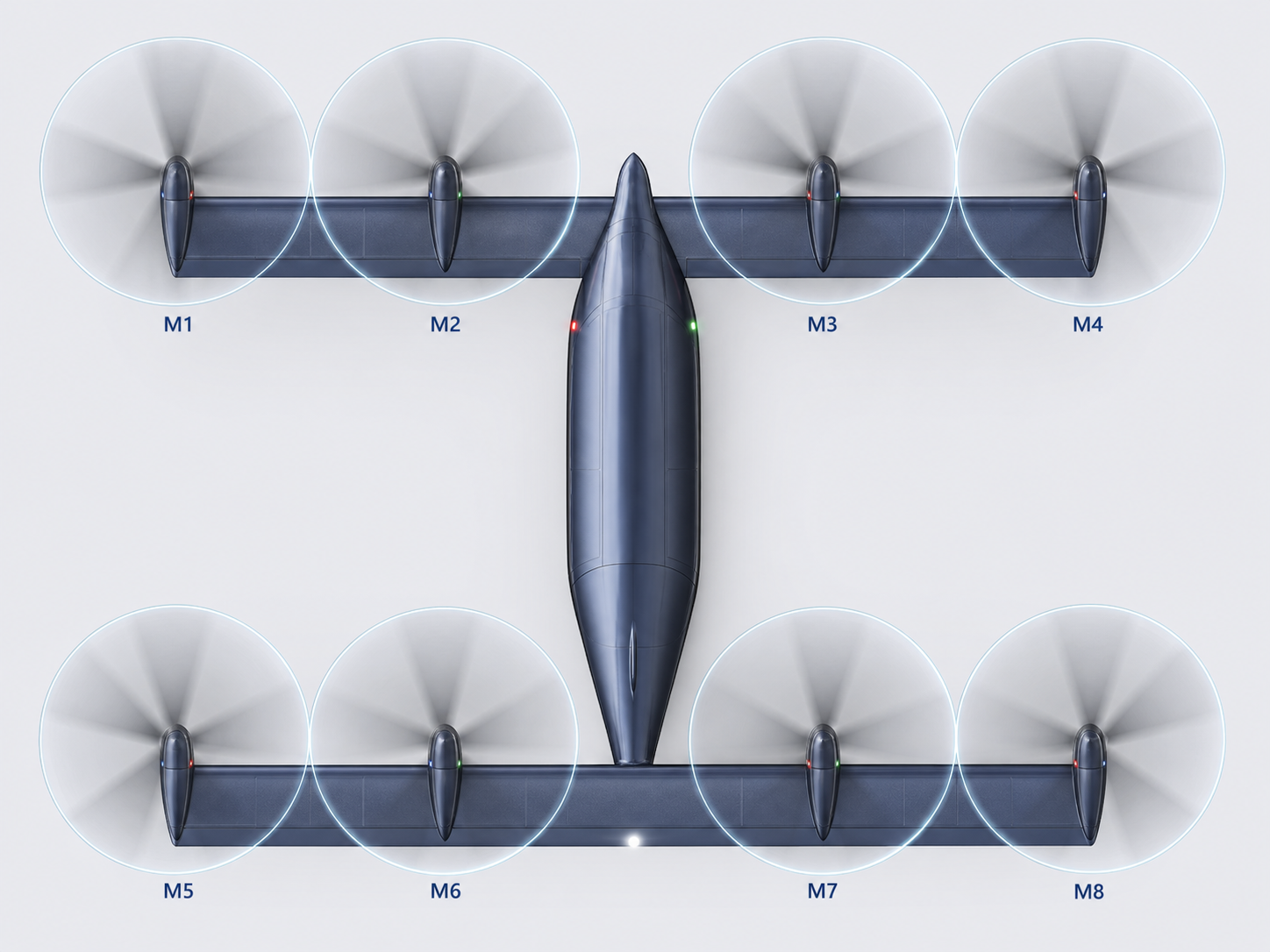
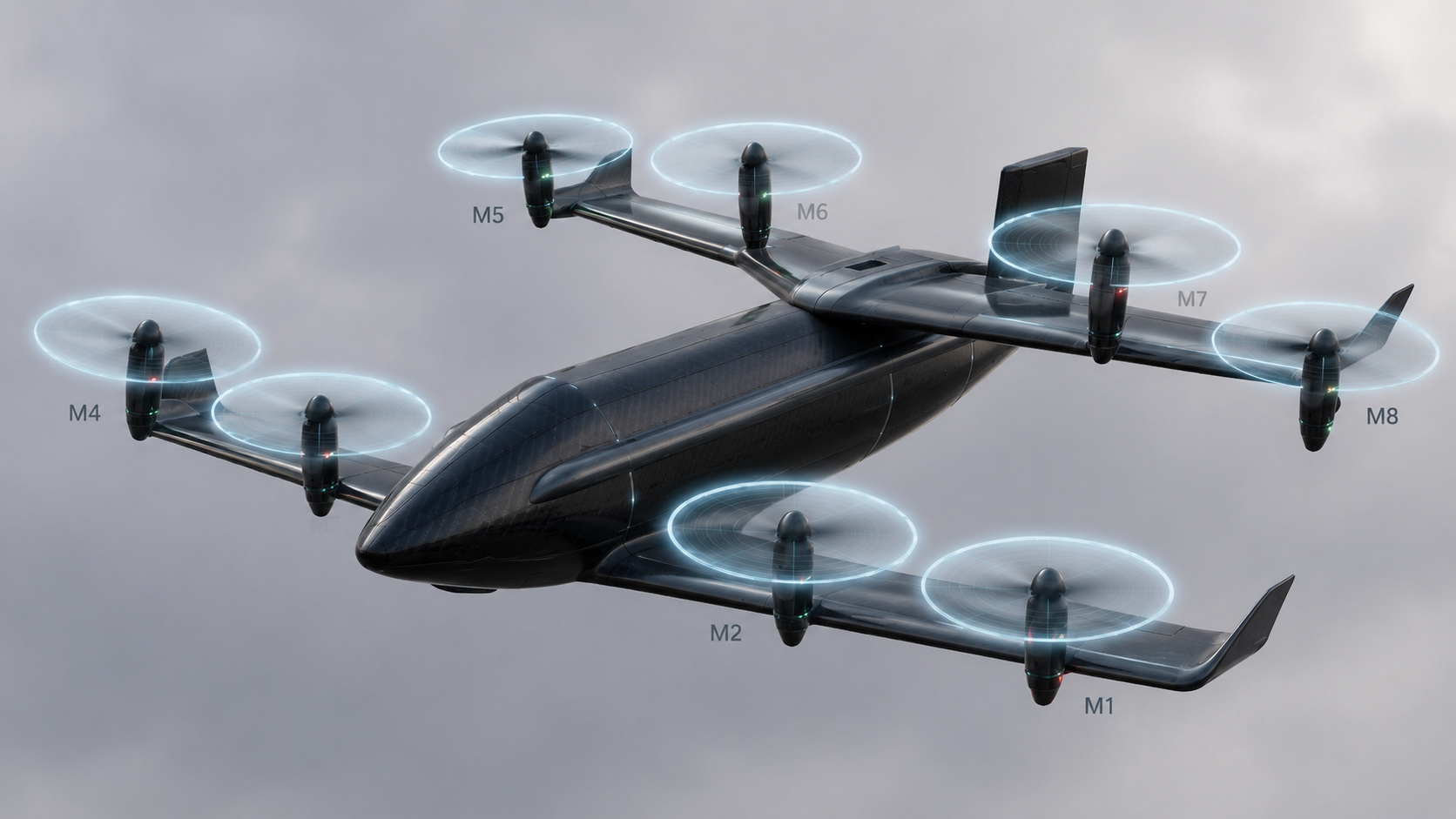
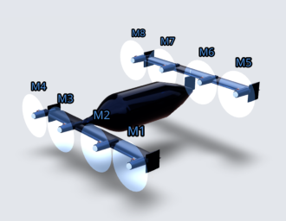
Top view of Lambda showing its asynchronous tilting propulsors and aircraft structure
Patent Foundation

Independent Asynchronous Tilt Propulsion

Flight is controlled without conventional control surfaces. Eight identical propulsors tilt independently, while software switches between prevalidated flight modes.

  • Lower certification complexity
  • Lower manufacturing cost
  • Predictable deterministic control
  • Scalable architecture from 25 kg to 890 kg
Explore All Patent Technologies
Aircraft Class and Certification Roadmap

One Technology Scales Across Four Aircraft Classes

We validate flight transition on a small aircraft, then scale the same architecture to cargo and crewed platforms.

25 kg Class

Flight-Transition Validation

Validates asynchronous tilting and deterministic control on a real aircraft.

220 kg Class

Lightweight Crewed and Uncrewed Expansion

Validates operations and regulatory pathways for the lightweight class.

599 kg Class

Uncrewed Cargo with a 300 kg Payload

Validates repeated operations and the economics of regional routes.

890 kg Class

475 kg-Payload Uncrewed Cargo and Four-Seat Crewed Expansion

Expands from the primary cargo platform into regional passenger transport.

Explore Products and Regulatory Pathways
Market Entry

Start with Cargo. Expand into Regional Aviation.

Repeated cargo operations generate flight data and revenue, enabling the same platform to expand into regional passenger transport.

  • Medical Logistics
  • Emergency Transport
  • Industrial Logistics
  • Island Transportation
  • Regional Passenger Mobility
Explore Markets and Routes
Receivepower

We Develop Software-Defined Aircraft

Our mission is not simply to build another eVTOL. We are creating an aircraft architecture that is easier to certify, less expensive to manufacture, and scalable across multiple aircraft classes.

Deterministic Flight. Faster Certification. Lower Cost.

Company

Receivepower

We have been building intelligent robots since 2019 — from walking humanoids to flying aerial robots — machines that move with Physical AI.

Mission

We are turning the flying car into a real aircraft.

Lambda SDA is a VTOL aviation platform that combines automotive-level cost structure with software-defined flight.

View Development Narrative
Patent Foundation

It began with an asynchronous tiltrotor patent.

In 2020, we filed and registered a patent for the asynchronous tiltrotor structure. It was designed to target hover takeoff and landing safety and one-tenth the operating cost of conventional aircraft.

Development Narrative

Flying Car: From Dream to Reality

Everyone dreams of a flying car at least once. So did we. We believed the tiltrotor could be the aircraft that makes that dream real. But in 1992, the crash of the Osprey (V-22) raised one question for us: to fly safely over cities where people live, wouldn't it need to be a far safer tiltrotor?

An Old Dream, Three Barriers

For that dream to become urban transportation, three problems had to be solved at once: take off and land in place, fly far, and move safely between those two modes. No aircraft has ever combined all three.

The Possibility of the Lambda Engine

It began with calculation. In 2006, looking at Korea’s independently developed Lambda automotive engine, we asked: could an aircraft fly with this engine? Counting seats from engine weight and output gave an answer: a Gamma engine for two seats, a Lambda engine for three. On paper, an aircraft built from automotive parts was already achievable.

The Invention of the Asynchronous Tiltrotor

The remaining problem was safety. We drew and erased more than 200 hover takeoff and landing aircraft forms. At the end, we arrived at a structure that tilts each rotor separately — the asynchronous tiltrotor — and filed the patent in 2020.

After that, the company’s time went into humanoid robot development. The aircraft was folded away in a drawer. One day, while preparing robot mass production, the patent registration notice arrived for that idea in the drawer. A forgotten idea had returned as a right.

2026, Completion of the SDA Architecture

The registration notice wasn't a cause for celebration — it was a question. Can this structure truly open the sky? Starting from the first 2020 patent, we redesigned a patent network that connects every phase of operation from takeoff to emergency landing. The system completed in 2026 is the SDA architecture — five core technologies and about 25 inventions.

An Aircraft That Competes with Truck Freight Rates

SDA will not remain an idea on drawings. The flying car we dreamed of as children is now preparing to take off as an aircraft that competes with truck freight rates. It begins with cargo. At the end of that path is the day it carries people.

Company News

News from Receivepower.

News and media coverage on our technology, patents, product development, and business expansion.

Press Archive

News and Press

Investor Relations

Recurring revenue structure created by software-defined aircraft.

It creates recurring revenue beyond simple aircraft sales, expanding into fleet ownership, corridor operating rights, MRO, Flight OS, continuing-airworthiness data, and regional JVs.

VC

Certification: A Predictable Process

eVTOL certification has dragged on for years — we addressed the certification requirements at the design stage.

Certification is the central variable in an investment decision. We have made the certification schedule predictable.

The reason eVTOL company valuations fluctuate is simple: no one can confirm the certification schedule. The market sees this not as a question of technical capability, but as the risk of not knowing how much more capital will be consumed.

eVTOL must pass the following two FAA regulatory requirements.

  • Deterministic control: DO-178C
  • Power-off emergency landing: PL.2105(g) under FAA AC 21.17-4

We incorporated the two most demanding certification requirements into the aircraft design from the outset.

1. It responds only in predefined ways (DO-178C)

Conventional systems keep calculating answers in flight. Lambda switches immediately to answers validated in advance.

2. It lands under control even when the engine is off (PL.2105(g))

Even when the engine is off, control does not stop. In the extreme case of losing all power, the eight rotors create differences in air resistance — differential drag — forming virtual control surfaces. We designed a fail-safe that controls direction and trajectory to the end and performs a glide landing without power. SDA is an aircraft designed directly for PL.2105(g).

3. Certification-target components are reduced to about 1/100

Conventional aircraft have hundreds of failure points because of control surfaces and actuators, and each must be proven. We removed mechanical control surfaces themselves, dramatically reducing the components subject to certification.

4. We build trust with cargo before people

Instead of spending capital first on crewed-aircraft certification, we accumulate large volumes of real flight data through cargo transport. We fly cargo aircraft first and often, building the real-world flight record required for crewed-aircraft certification.

In conclusion, we simplified computation, reduced parts, and resolved emergency response through design. We address the technologies required for certification at the design stage, making the remaining process predictable.

↑ Back to Contents
Individual Investors

Technology that redesigns the sky

Receivepower uses AI and robotics to design the expansion path of software-defined aircraft. From aircraft structure to control, production, and operation, we rewrite the fundamentals so aviation can operate in a more efficient and accessible way.

If you're interested in deep tech, you'll likely resonate with the vision and technical scalability we're building. Information on individual investment participation will be provided separately when ready.

↑ Back to Contents
KRW 100 million

This is the initial asset unit from an investor's perspective. An aircraft priced at approximately KRW 100 million expands into fleet, corridor operating rights, MRO, and Flight OS revenue.

KRW 5 billion

From an IR perspective, the core is not aircraft sales but lifetime operating revenue. As repeated operating data accumulates, the basis for certification, insurance, maintenance, and software revenue grows.

50%

For investment decisions, utilization and durable margins matter more than manufacturing cost alone. The low-maintenance structure and Flight OS help protect fleet profitability.

Initial Entry Market

Routes where missing a ship costs a day and switching back to road transport costs half a day — that time loss is Lambda’s initial market.

Investment Structure

It expands into a fleet/JV structure that bundles corridor operating rights, local assembly, MRO, data accumulation, and Flight OS subscriptions.

Investment Logic

We design fleet infrastructure and recurring software revenue together.

Lambda combines fleet ownership, leasing, corridor operation, logistics SLAs, continuing-airworthiness data, and Flight OS subscriptions to build a recurring revenue structure.

Why Now

Once air logistics costs fall to truck level, the logistics map is redrawn — no longer along roads, but in straight lines toward destinations.

Straight-line distance becomes the new basis for logistics-network design. A 475 kg payload in the 500 kg class and up to 1,000 km of range target the air mid-mile logistics market.

Recent News

Recent Coverage for Investors

Key news related to patents, certification, investment, and business expansion.

View All News and Press
Technology

Robotics Technology

Aerodynamics alone do not make Lambda fly. Receivepower connects the Physical AI technologies that move real machines into a single execution system, then builds software-defined aircraft on that foundation. Aircraft-specific technologies such as the asynchronous tiltrotor and virtual control surfaces are covered on the IP page.

Physical AI

AI That Moves in the Physical World

Control intelligence that reads state through cameras and sensors, predicts possible failure, and lets real machines choose the next action.

Robot Middleware

Robot Middleware

The execution layer that lets sensors, motors, controllers, simulators, and AI models exchange data.

Industrial Control

Industrial Control

It connects control systems proven in factories and machines — PLC, CAN, EtherCAT, safety relays — to real equipment.

Coordinate System

Coordinate Systems

It aligns the robot body, hand, camera, workpiece, and spatial reference points into one mathematical position relationship.

Sensor Fusion

Sensor Fusion

It combines camera, IMU, encoder, current, and force-sensor signals to determine the machine’s state reliably.

Virtual Space

Virtual Space

Digital twins and simulations verify motion, collision, and failure conditions before real equipment is built.

Vision

Vision

Object recognition, segmentation, pose estimation, and inspection structure the targets a robot must see and judge.

Manipulation

Manipulation

It designs real object-handling actions such as grasping, placing, insertion, alignment, and stacking.

Contact Control

Contact Control

It reads force, torque, slip, and pressure so robots can interact delicately with objects and environments without collision.

AI Model

AI Models

Vision models, behavior policies, anomaly detection, and imitation learning train robot judgment and action selection.

Workcell

Workcells

A real work unit where robot arms, mobile robots, grippers, cameras, lighting, jigs, and conveyors work together.

Factory Data

Factory Data

Production count, cycle time, fault history, inspection results, and quality data are collected for operational decisions and improvement.

Safety

Safety

Emergency stops, safety zones, speed limits, collision detection, and recovery procedures create the conditions for people and equipment to work together.

Engineering System

Engineering Systems

Requirements, interfaces, state machines, tests, and validation reports turn machine development into a repeatable process.

Patent Portfolio

Five core technologies change the cost and safety structure.

The world's first asynchronous tiltrotor architecture. Receivepower's five core technologies and portfolio of approximately 25 patents create exclusive advantages in aircraft price, safety and certification, and maintenance.
How to Read the IP

Receivepower IP should be read through airframe structural change and operational effect, not just by technology names. Each moat directly determines aircraft price, maintenance cost, utilization, and safety in the order of configuration, change, and effect.

  • EconomicsA direction that reduces mechanical parts, production steps, and maintenance items
  • SafetyTurning transition, failure, power loss, and state-recognition behavior into a provable structure
Registered

1. Independently Controlled Tilting Thrust Units

They structurally stabilize transition flight and provide a foundation that can scale to crewed passenger transport.

Filed

2. Flight Control Based on Virtual Control Surfaces

Flight is controlled without physical control surfaces, significantly reducing production complexity and maintenance requirements.

Filed

3. Discrete-Matrix-Based Flight Management System

Every response of the flight algorithm is verified in advance, improving the predictability of certification schedules and budgets.

Filed

4. Power-Off High-Lift Control

Even after a total loss of power, the aircraft retains control of its direction and trajectory through landing.

Filed

5. SADS-Based Virtual Pitot Tube

The aircraft can determine its flight state even if a single physical sensor fails.

The SDA Architecture Built by Five Technology Moats

  • Truck-Level EconomicsVirtual control surfaces, no-control-surface structure, and simplified production and maintenance
  • Crewed-Flight SafetyTilting transition, discrete control, power-off high lift, differential drag, and SADS state estimation complete one certification logic
  • SDAAn aircraft architecture that starts from operating conditions and failure scenarios
IP LOGIC Why This Structure: Five Design Logics
01

Why Tiltrotor: Expanding Market Size

To enter the urban air market, hover takeoff and landing capability is essential; to expand into wider mobility markets, wings that can fly far are essential.

No unused propulsor remains as a dead rotor in flight, allowing one propulsion architecture to deliver both hover takeoff and landing and efficient fixed-wing cruise.

02

Why Independent Tiltrotor: Predictable Certification Timeline

Conventional tiltrotors rely on complex probabilistic control, making passage through stringent software certification standards such as DO-178C uncertain. This is the fundamental reason existing tiltrotor-based eVTOL companies carry both high valuations and uncertainty.

Independent control makes every flight response traceable and reproducible. Because the flight algorithm is deterministic, certification time and budget can be predicted.

03

Why Virtual Control Surfaces: Lower Manufacturing and Maintenance Cost

Physical control surfaces and mechanical actuators are removed, and flight is controlled through software-based rotor control.

Reducing mechanical linkages simplifies production and brings aircraft price down toward 10% of conventional levels.

As moving parts fall to one-hundredth, wear and failure factors decrease, reducing operating maintenance cost and maintenance time.

04

Power-Off Flight Capability: Entry Condition for the Regulatory System

FAA guidance (AC 21.17-4 Appendix A, PL.2105(g)) states that controlled emergency landing capability through glide or autorotation is required even when power is lost. SDA builds the power-off control logic for an aircraft with no moving wing parts through rotor-by-rotor autorotation and differential drag.

Actual operating approval can only be obtained once this legal standard is met.

05

SDA Integrated Value: Price Competition with Ground Freight

SDA is an architecture that simultaneously achieves deterministic flight control, power-off emergency landing capability based on autorotation and differential drag, and extreme parts simplification.

It secures high safety while lowering production and maintenance costs — competing directly with ground freight markets on price, beyond the aviation sector itself.

SDA Visual

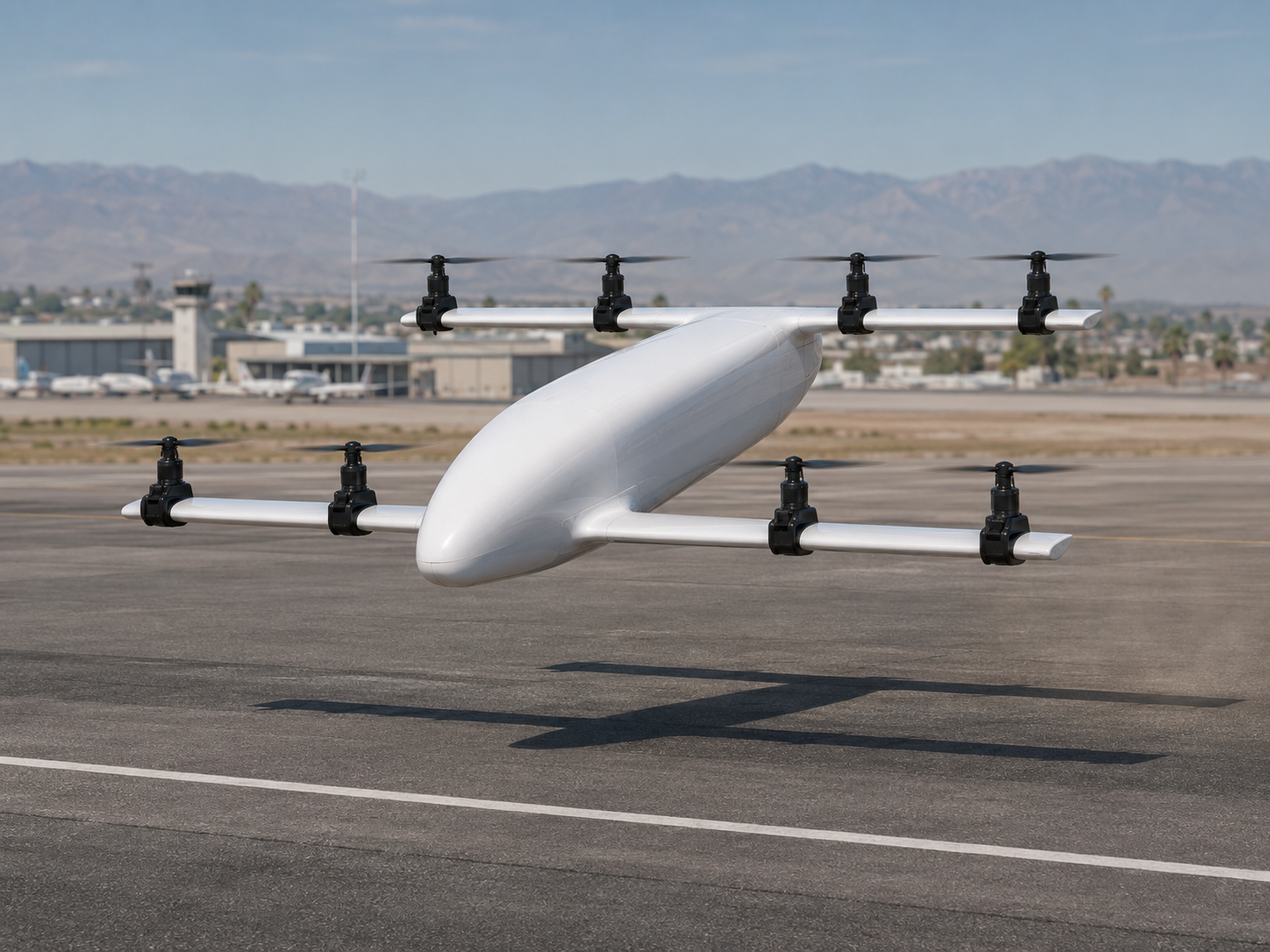
Asynchronous tiltrotor flight example

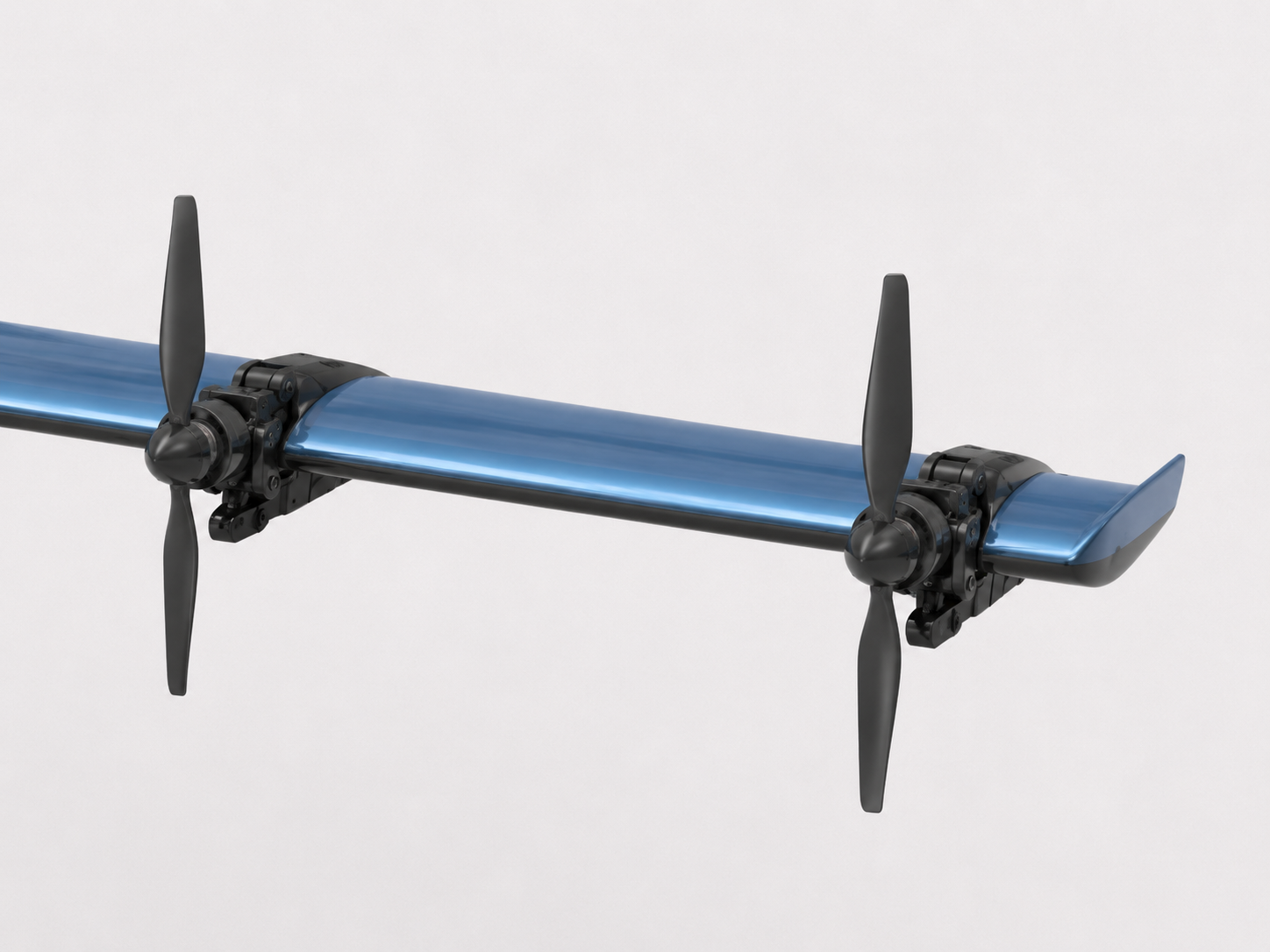
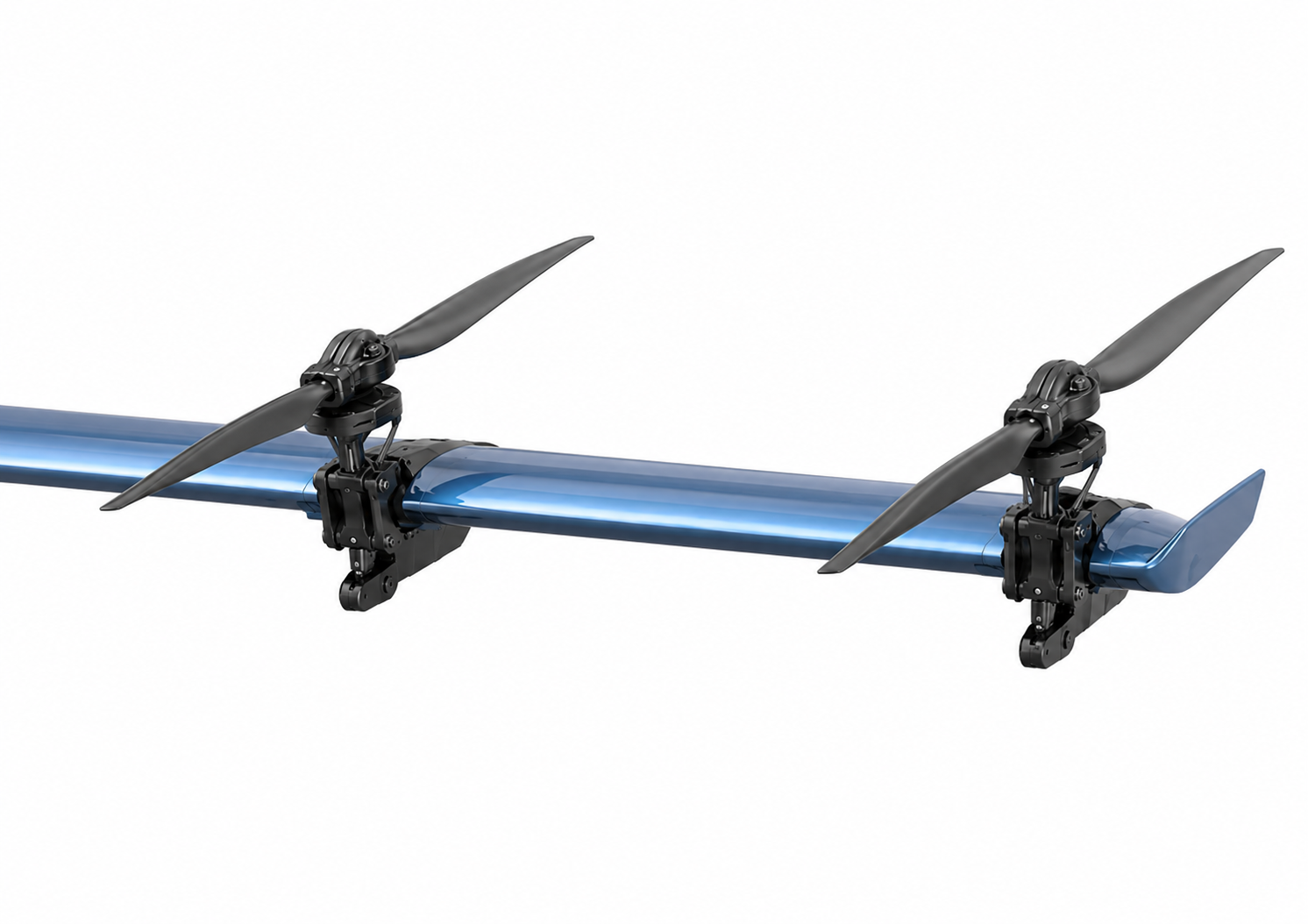
SDA hover tilt-nacelle detail
VTOL

Hover takeoff and landing tilting nacelle

Every rotor tilts independently.

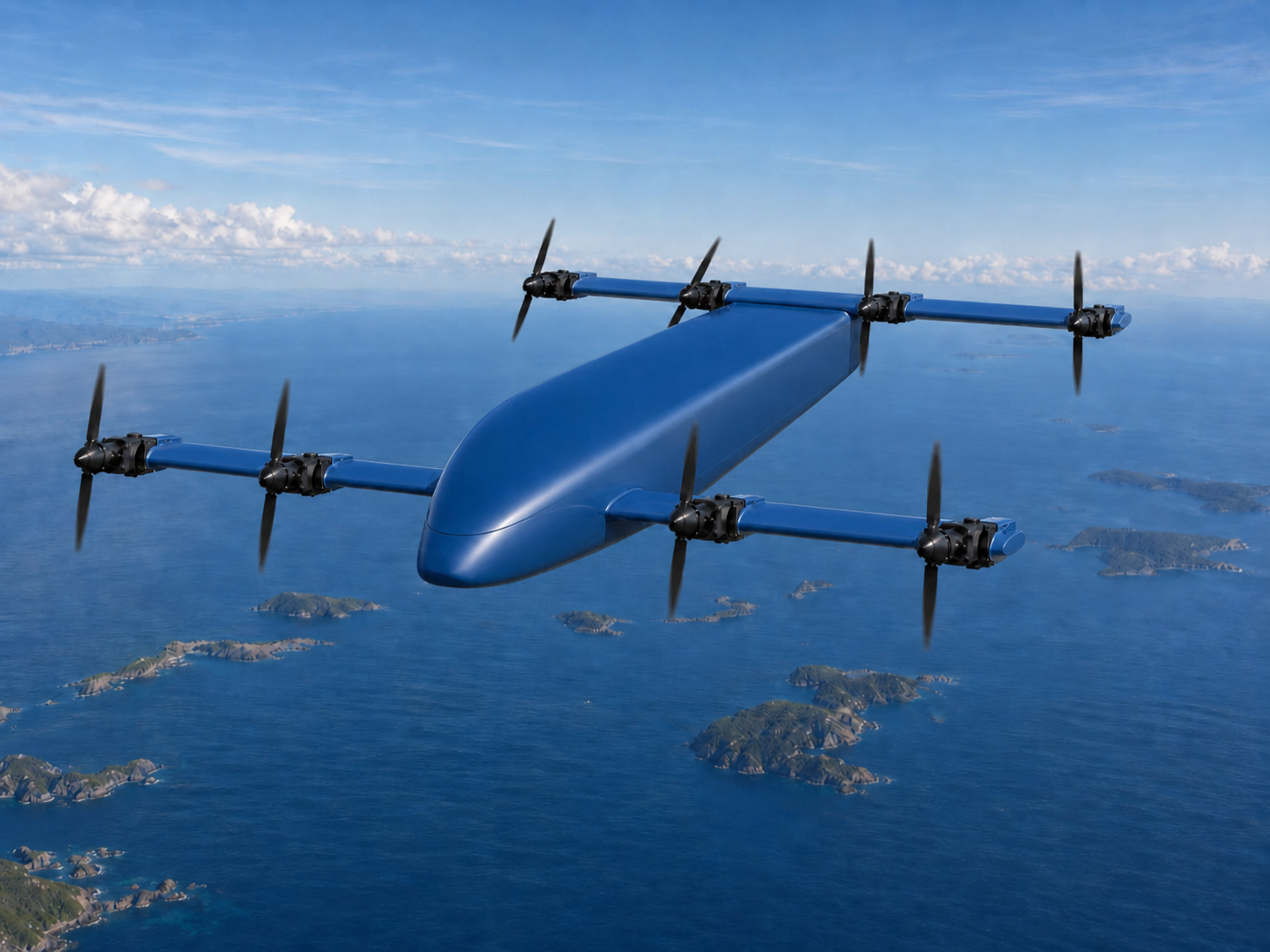
SDA cruise tilt-nacelle detail
CRUISE

Transition to fixed-wing cruise

Hover thrust devices transition into cruise thrust to secure the efficiency of long-range air logistics.

SDA top-view propulsor layout
LAYOUT

A structure that flies without control surfaces

Propulsor layout and differential-thrust control replace moving control surfaces. The stagger-based virtual control surface is explained in the detailed technology section.
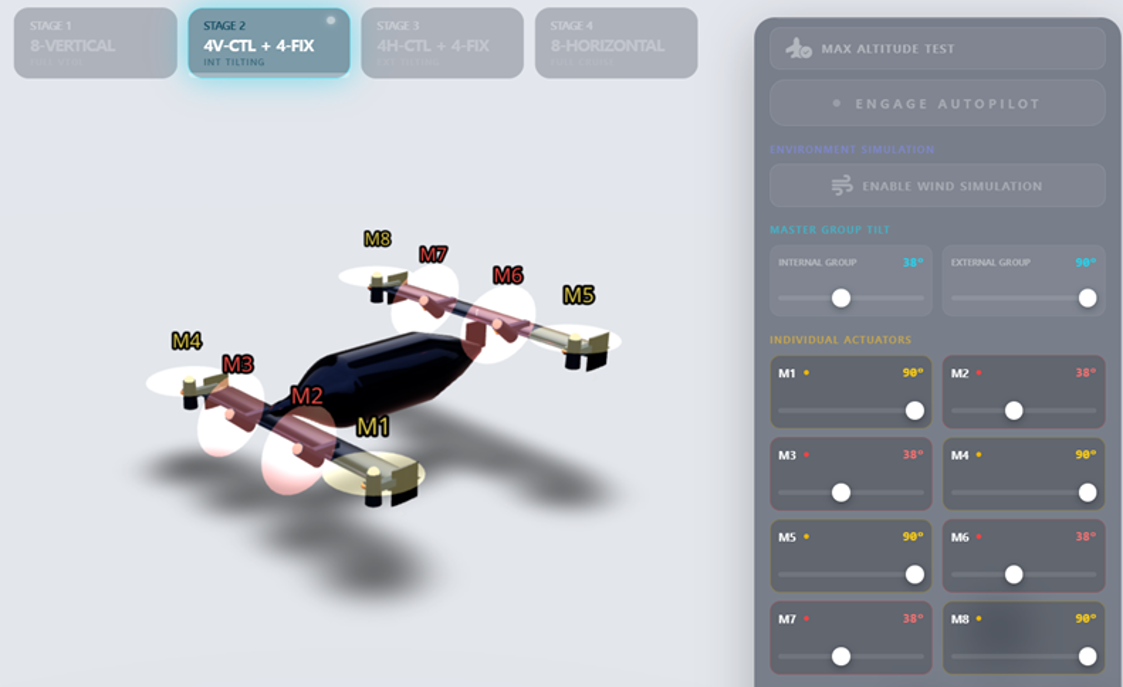
SDA asynchronous distributed-propulsion control interface
CONTROL LOGIC

The eight propulsors each move differently.

This is the SDA transition structure: inner and outer propulsors are separated and tilted in stages, with control authority transferred by flight mode.
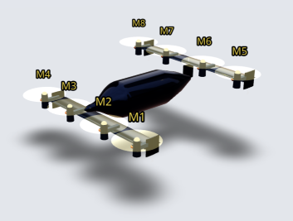
SDA hover takeoff mode
01

Hover Takeoff

Eight propulsors lift off with hover thrust.
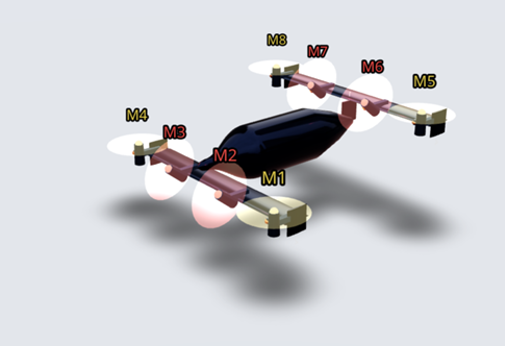
SDA first tilt stage
02

First Tilting

Some propulsors begin transition first.
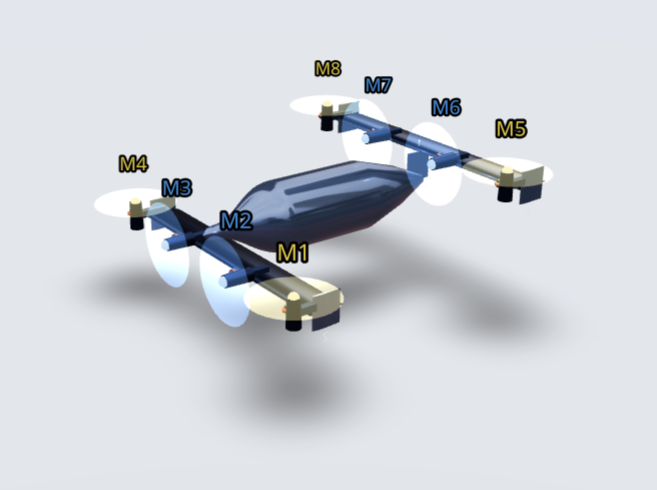
SDA first tilt completion and cruise-control transfer
03

Control Authority Transfer

Hover thrust and cruise control are handled at the same time.
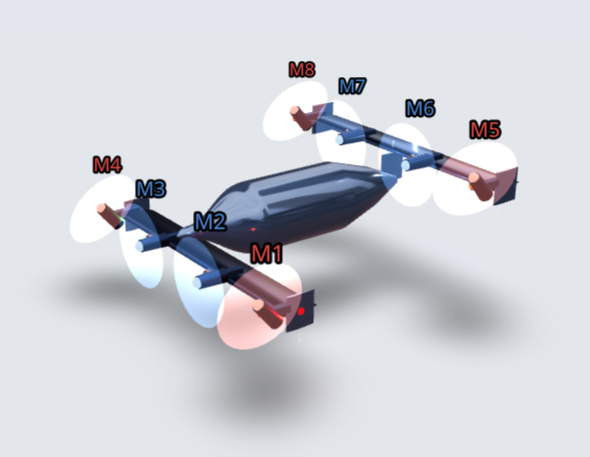
SDA second tilt in progress
04

Second Tilting

The remaining propulsors move into the cruise direction.
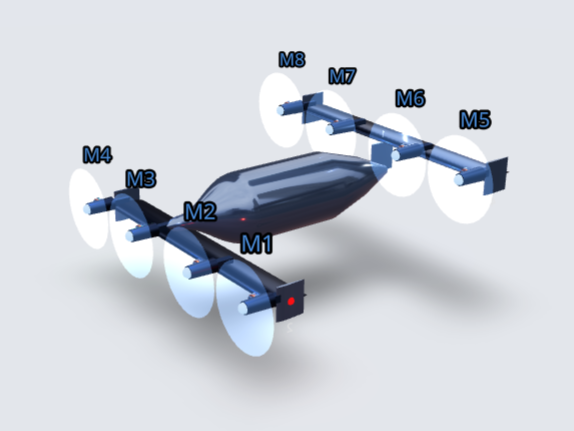
SDA full cruise-control authority
05

Cruise Control Authority

After transition is complete, full cruise control authority is secured.
SDA cruise flight
06

Cruise Flight

Fixed-wing cruise secures distance and economics.

Product Direction

Cargo-first Aerial Robot.

By removing moving wing parts, reducing components to one-hundredth, and turning certification into a procedure, Lambda proves it first.

Product

Lambda approaches the market with a cargo-first strategy

It proves itself first through cargo operations.

Lambda accumulates flight data and safety structure through 100–500 kg-class cargo operations.

This validation leads to crewed powered-lift and autonomous passenger transport.

Technology Stack

  • Safe VTOLAsynchronous Tiltrotor Architecture
  • Deterministic FlightMode-aware matrix-based control
  • Simple aircraftFixed-wing structure with no moving wing control surfaces
  • Safety marginPower-off glide, autorotation, and differential-drag control
Aircraft Classes and Regulatory Tracks

Expanding from four classes into seven crewed and uncrewed variants

The 25 kg class begins as one uncrewed type. The 220 kg, 599 kg, and 890 kg classes divide into uncrewed and crewed types, and the regulatory track differs by class and operating purpose.

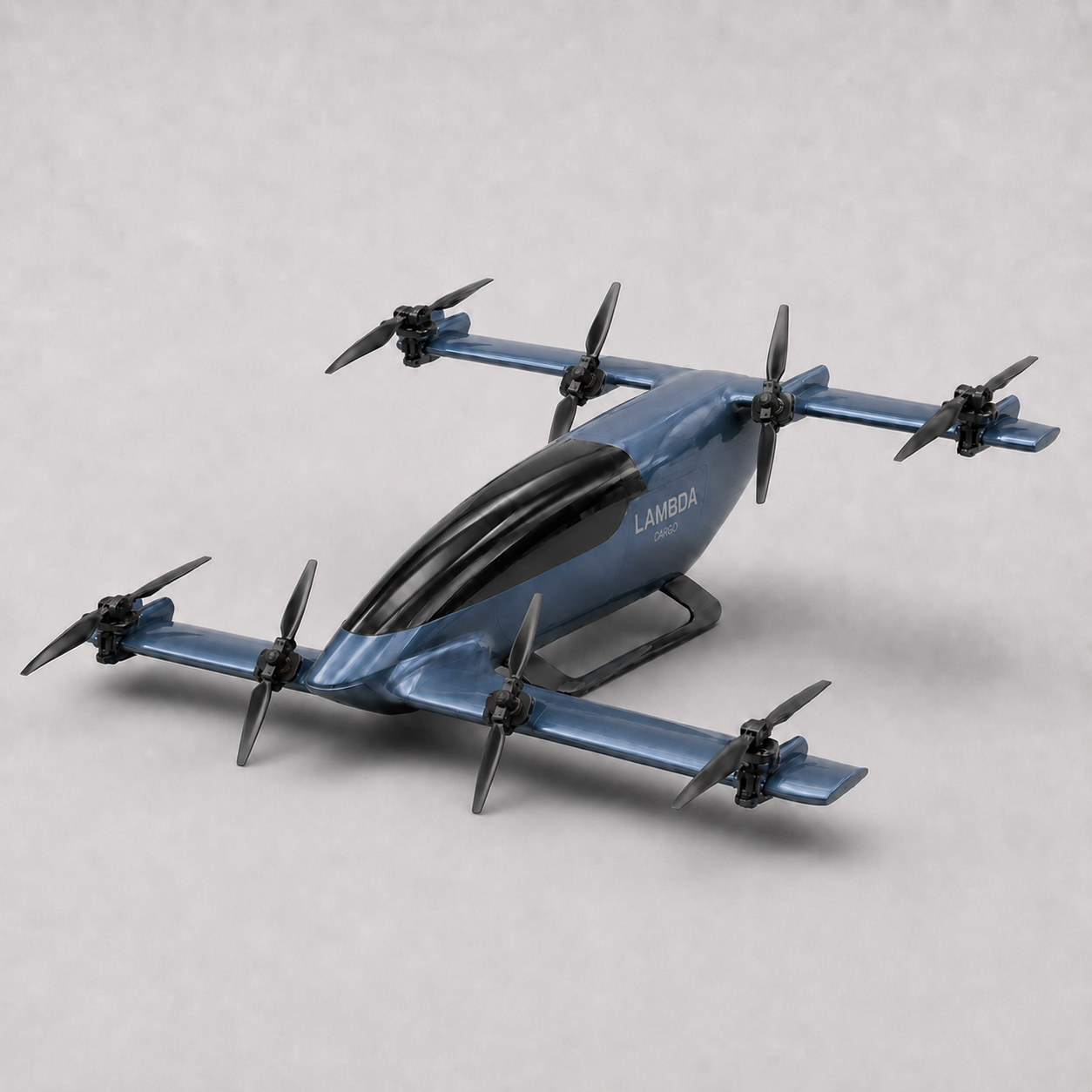
Spectator Part 107 -class Lambda aircraft image
01 · UNMANNED

Spectator

An uncrewed 25 kg-class demonstrator that validates asynchronous tilting and deterministic control in actual flight. It begins demonstrations and early commercial operations under the sub-55 lb small UAS standard (Part 107).

  • Class25 kg class
  • OperationUncrewed
  • PL / MTOW10 kg / 25 kg class
  • Regulatory TrackFAA 14 CFR Part 107
Hecatoncheir Part 108 -class Lambda aircraft image
02 · UNMANNED

Hecatoncheir

A 220 kg-class uncrewed cargo aircraft that builds route data through repeated beyond-visual-line-of-sight (BVLOS) operations. It follows the Proposed Part 108 pathway, which covers aircraft up to 1,320 lb.

  • Class220 kg class
  • OperationUncrewed
  • PL / MTOW100 kg / 220 kg
  • Regulatory TrackFAA Proposed 14 CFR Part 108
Solo Part 103 -class Lambda aircraft image
03 · CREWED

Solo

The single-seat crewed variant of the same 220 kg-class platform. Its applicability under Part 103 is being evaluated against ultralight empty-weight, speed, and fuel limits.

  • Class220 kg class
  • OperationCrewed
  • Seats / MTOW1 seat / 220 kg
  • Regulatory TrackFAA 14 CFR Part 103 review
Heavy Part 108 -class Lambda aircraft image
04 · UNMANNED

Heavy

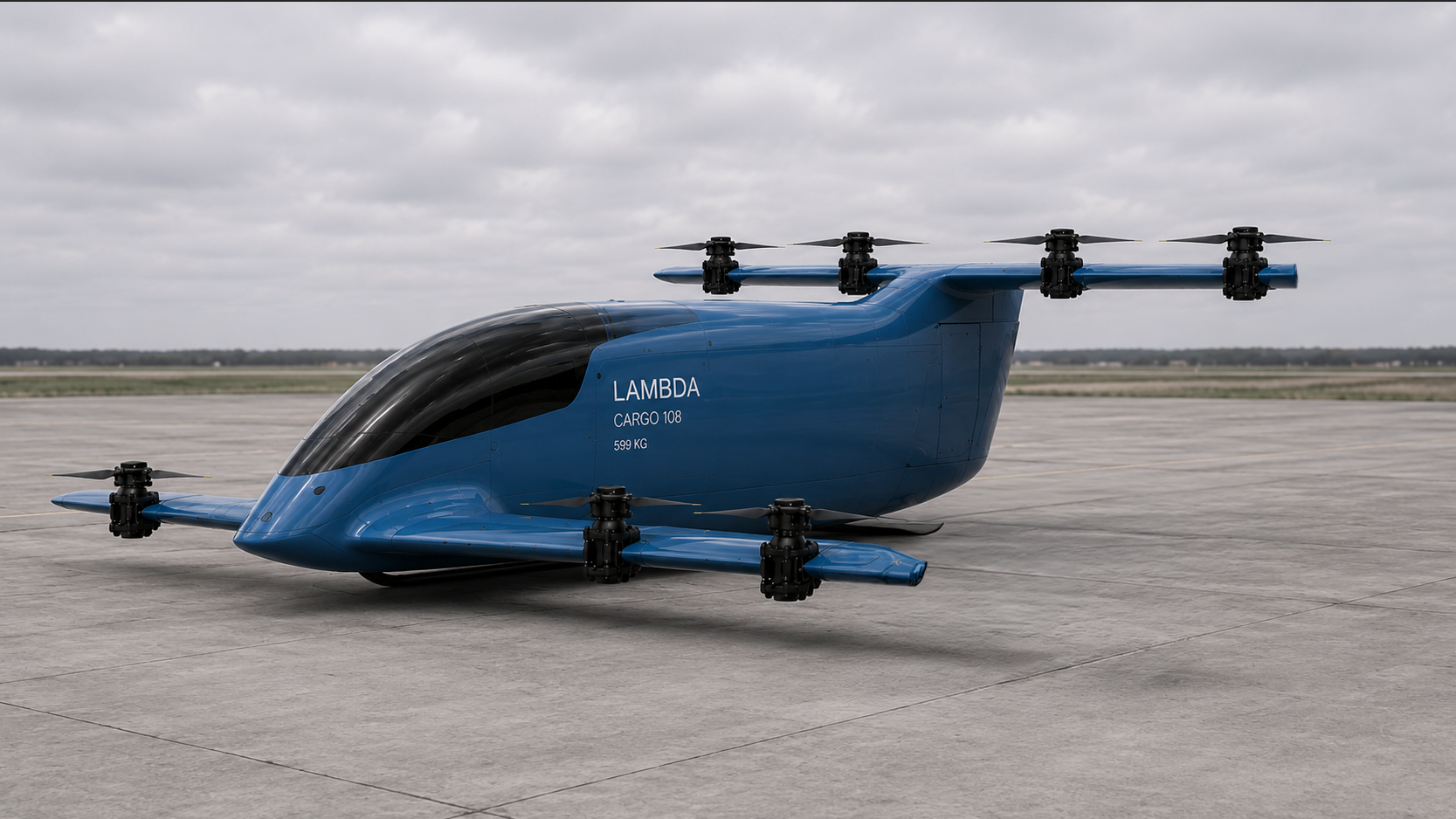
The primary uncrewed industrial and logistics aircraft, with a 300 kg payload. It targets repeated BVLOS operations at the 599 kg-class upper limit of Proposed Part 108.

  • Class599 kg class
  • OperationUncrewed
  • PL / MTOW300 kg / 599 kg class
  • Regulatory TrackFAA Proposed 14 CFR Part 108
Heavy Part 22 -class Lambda aircraft image
05 · CREWED

Heavy

A lightweight crewed variant of the 599 kg-class platform. Certification is planned under the performance-based consensus standards of MOSAIC Part 22.

  • Class599 kg class
  • OperationCrewed
  • Seats / MTOWTBD / 599 kg
  • Regulatory TrackFAA 14 CFR Part 22 · MOSAIC
Eureka Part 21 -class temporary Lambda aircraft image
06 · UNMANNED

Eureka

The top-tier uncrewed cargo aircraft, with a 475 kg payload. Derivative configurations are managed through the Part 21 type-certification system and the §21.91 type-design change procedure.

  • Class890 kg class
  • OperationUncrewed
  • PL / MTOW475 kg / 890 kg
  • Regulatory TrackFAA 14 CFR Part 21 / §21.91
Eureka powered-lift -class temporary Lambda aircraft image
07 · CREWED

Eureka

The four-seat passenger variant of the 890 kg-class platform. As a §21.17(b) special-class powered-lift aircraft, it follows the AC 21.17-4 pathway for type, production, and airworthiness certification.

  • Class890 kg class
  • OperationCrewed
  • Seats / MTOW4 seats / 890 kg
  • Regulatory TrackFAA AC 21.17-4 · Powered-lift

As of July 2026, Part 108 is a proposed rule. The LSA certification rule under MOSAIC Part 22 applies from July 24, 2026. The 25 kg and 599 kg classes are product class names; actual certification weight will be finalized against Part 107’s below-55 lb standard and Proposed Part 108’s 1,320 lb-or-below standard.

Market Entry

The first market is regional air logistics with repeated operations.

Receivepower first secures economics and operating data through cargo operations. In routes where ground and sea transport lose too much time, SDA validates repeated operations and uses that data to build the expansion path toward crewed flight.

Market

Routes where time loss costs more than air transport

▲ Busan Port
Tsushima
▲ Japan Mainland Hub
(Fukuoka / Kitakyushu / Shimonoseki)

Some routes are too slow by road, schedule-bound by sea, and too expensive for conventional aircraft.

Lambda is air-logistics equipment built to fill that gap. It provides direct air access where time loss reduces product value and safety, such as island logistics, mountain supply, industrial cargo, and emergency delivery.

  • Island logistics Cargo access without port dependence
  • Industrial cargo Parts, tools, batteries, samples
  • Autonomous cargo Fixed-wing cruise + VTOL accessibility
Unit Economics

Cargo revenue and data open the path to crewed flight

The market needs economics that beat truck freight rates, not merely a better aircraft.

Air logistics opens only when aircraft cost, energy, maintenance, safety, certification, and utilization all align. Lambda reduces these cost layers through airframe structure and operating software together.
Design innovation lowers both aircraft cost and operating cost.
Aircraft cost, maintenance burden, cruise energy, and utilization are tied into one logistics-asset economics.
Aircraft cost 1/10 target
Aircraft with no control surfaces Automated production path
Maintenance burden Reduced part count
Reduced mechanical control surfaces Reduced inspection items
Energy cost Fixed-wing cruise
Long range without multicopter energy limits Practical regional routes
Korean Local Governments

Turning regional problems into air-logistics routes.

Initial demand lies in routes where road and sea transport lose time: island logistics, medical samples, urgent industrial parts, and port connections.

The Market page presents demand and route potential first. Contracts, research projects, and dedicated-aircraft development are covered on the Business page.

View Partnership Structure → Business
Japanese Local Governments

There is demand for regional air logistics connecting islands and ports.

Japan's islands, ports, industrial parks, and medical hubs are a market where air mid-mile logistics can operate alongside regional industry.

The Market page explains route potential and regional demand. Local assembly and MRO hubs, JVs, and operating structures are covered on the Business page.

View Partnership Structure → Business

Japan Mainland - Busan Port

Busan to Fukuoka takes three hours by sea and about 59 minutes by Lambda. This corridor is an early example of SDA economics where surface transport loses substantial time.

  • Flight DistanceApprox. 200–215 km
  • Cruise Flight TimeApprox. 50–59 minutes
  • Direct One-Way Aircraft Operating CostApprox. KRW 96,000–104,000
Business
Partnership Structure

Opening the AAM market with diverse partners.

  • Patent LicensingIP, technical white papers, Flight OS / independent product development
  • Development JVDesign, control, patent architecture / joint product equity
  • Manufacturing JVSimple airframe, COTS supply chain / assembly and MRO revenue
  • Operations JVAircraft, Flight OS, airworthiness data / route operating revenue
Patent Licensing

Patent Licensing

Asynchronous tilting, virtual control surfaces, discrete control matrices, power-off high-lift and differential-drag control, and the SADS virtual pitot system form SDA's core IP. Rather than selling only complete aircraft, we build recurring revenue through Flight OS, technical white papers, IP licenses, and running royalties.

Development JV

Development Joint Venture

Receivepower provides design, control, software, and patents as a standard architecture, while partners scale it with capital and supply chains.

Manufacturing JV

Manufacturing Joint Venture

Regional manufacturing JVs handle plants, equipment, local permits, and assembly labor. Receivepower designs a no-control-surface, COTS-based structure that manufacturing partners can assemble and replace quickly.

Operations JV

Operations Joint Venture

With logistics companies, we can form operations JVs that combine shared fleets by corridor, route co-investment, flight-data accumulation, MRO, and Flight OS. Partners provide logistics demand and hub operations, while Receivepower integrates the aircraft, flight-operations software, and continuing-airworthiness data into a repeatable service model.

Revenue Stack

Revenue does not end with aircraft sales.

SDA's objective is not merely hardware manufacturing, but the cost structure and operating standard of air logistics. Aircraft sales, leasing, corridor rights, MRO, Flight OS, continuing-airworthiness data, and regional JVs create long-term revenue.

Lambda Architecture

Lambda's Essential Competitive Advantage

Conventional aircraft keep adding control surfaces, linkages, hydraulics, and variable-pitch mechanisms to gain more flight capabilities. As the parts count rises, so do manufacturing, maintenance, and certification costs.

Lambda takes the opposite approach. Eight identical propulsion modules provide vertical takeoff and landing, cruise, transition flight, and emergency landing within a single architecture. There are no control surfaces, variable-pitch mechanisms, or complex mechanical flight-control systems.

The result is fewer parts, production closer to automotive and industrial electric machinery, and a dramatically smaller set of components to certify.

Once proven through repeated operations, Lambda will be more than another eVTOL. It will be a platform that changes the cost structure of both aircraft manufacturing and air transport.

Korean Local Governments

A UAM program should begin by validating the aircraft, route, and economics before building vertiports.

Receivepower first designs the route and demonstrator aircraft around local conditions.

What Regional Air Logistics Delivers to Local Governments

  • Solve Local ChallengesImprove access in underserved medical, transport, and logistics areas while strengthening public services.
  • Deliver Measurable Policy OutcomesTurn regional-decline response, emergency care, community infrastructure, and smart-city policy into measurable outcomes.
  • Build a Basis for National FundingCreate the evidence needed for national programs and matched national and provincial funding.
  • Develop Regional IndustryBuild a regional aviation industry and employment base through operations, maintenance, and training hubs.
  • Strengthen the Regional BrandEstablish an innovation-city identity through a pioneering domestic air-logistics demonstration.

Program Process

Phase 1 · Regional Air-Logistics Feasibility Study

Approximately KRW 20 million · Approximately 1 month

Analyze local terrain, industry, and logistics demand to assess the feasibility of air logistics.

  • Select target routes
  • Analyze operating economics
  • Develop an implementation roadmap

Phase 2 · Demonstrator Aircraft Development and Preparation

Approximately KRW 500 million · Approximately 12 months

Develop a demonstrator aircraft for the selected route and mission, then prepare it for operations.

  • Demonstrator aircraft
  • Flight-test and operational data
  • Certification support materials

Phase 3 · Regional Demonstration Operations

Validate services tailored to regional needs through actual operations.

  • Emergency medical specimen and pharmaceutical transport
  • Everyday logistics for islands and mountain communities
  • Urgent industrial-complex parts transport
  • Disaster-response support

Simulation Technologies for Local Governments

Before flying an aircraft, Receivepower first simulates the route and the city.

Route-Feasibility Simulation

Model local terrain, industrial distribution, and cargo demand to calculate route economics in advance.

  • InputsDistance, candidate takeoff and landing sites, cargo type, and operating frequency
  • OutputsOne-way operating cost, break-even cargo volume, and route priorities

UAM City Simulation

Before placing corridors and takeoff and landing sites over cities and regions, validate noise, safety, and traffic impacts in a virtual environment.

  • Inputs3D city model, corridor design, and candidate takeoff and landing sites
  • OutputsEarly review of community acceptance and evidence for permitting

Digital-Twin Demonstration Simulation

Before flying the actual aircraft, validate motion, collision, and failure conditions in a virtual environment.

  • InputsDigital Twin, Physics Engine, Scenario Generation, Failure Replay
  • OutputsLower demonstration risk and prepare test data for certification authorities in advance

Profitability and Operations Simulation

Combine lease, maintenance, and utilization assumptions by corridor to calculate the return structure for local governments and operating partners.

  • InputsLease payments, MRO cost, utilization, and Flight OS subscription
  • OutputsLifecycle revenue potential, target margin, and payback period

These four simulations are performed together during the Phase 1 feasibility study.

Request a Regional Air-Logistics Review

We analyze local conditions and explain the scope, schedule, and process of the feasibility study.

Request a Regional Air-Logistics Review
Japanese Local Governments

Air routes create local assembly and maintenance jobs.

For Japanese local governments, we propose dedicated-aircraft development together with local assembly and MRO hubs. Regions with dispersed islands, ports, industrial parks, and medical hubs can build air mid-mile logistics and local industry together.

  • Phase 1 · Route DesignDefine recurring demand among islands, ports, industrial parks, and medical hubs
  • Phase 2 · Aircraft SpecificationSet payload, range, and takeoff/landing conditions for the regional mission
  • Phase 3 · Assembly and MRO HubPlan local assembly, maintenance, and operator training
  • Initial CandidateBusan Port–Japan mainland corridor, approx. 200–215 km / 50–59 minutes
Ask About Partnership in Japan
Drone and Aircraft Companies

Develop on a validated architecture without starting from the IP problem.

We develop aircraft for your mission on a 25-invention IP network and Flight OS, from specification through certification-data accumulation.

Collaboration can extend from mission-specific aircraft specifications to rotor and propulsion layout, control software, certification data, and regional operating models.

Ask About Technology Partnership
Robotics and Humanoid Companies

Add an Aerial Leg to Your Robotics Network.

SDA connects hubs while ground robots handle unloading, sorting, movement, and maintenance.

Receivepower's Physical AI centers on sensor fusion, state estimation, control, and anomaly response, extending from aircraft control into logistics robotics.

Ask About Robotics-Logistics Integration
Logistics Companies

Busan–Fukuoka direct one-way operating cost: about KRW 100,000. We are looking for partners to co-own this route.

For logistics companies, we propose shared fleet operations and route co-investment by corridor rather than a simple transport contract. The logistics partner provides real cargo demand, hub operations, and service-level agreements, while Receivepower combines the aircraft, operating software, continuing-airworthiness data, and MRO structure.

  • Logistics Partner ProvidesCargo demand, hub operations, customer SLA
  • Receivepower ProvidesAircraft, Flight OS, continuing-airworthiness data, MRO structure
  • Initial Corridor ExampleBusan–Fukuoka approx. 200–215 km / direct operating cost approx. KRW 96,000–104,000

Initial corridors begin where time loss costs more than transport. As recurring flight data accumulates, revenue can expand into route leasing, operating rights, MRO, and Flight OS.

Request Route-Profitability Simulation
Customer Value

Customers aren't buying an aircraft. They're buying the ability to deliver cargo on time.

Logistics customers buy the ability to move a specified weight to a specified hub within a specified time. Lambda creates operating value through a 475 kg-payload mid-mile SLA in the 500 kg class, time savings, and repeat operating rates by corridor.

Cargo Operating Asset KRW 40–100 million

This range covers cargo operating assets from the 599 kg class to the 890 kg class. Local governments, operators, and regional JVs can structure returns through lease and operating contracts.

Lifecycle Revenue Potential KRW 5 billion

From a business perspective, recurring corridor volume is key. Lease fees, operating rights, MRO, Flight OS subscriptions, and continuing-airworthiness data services form lifecycle revenue.

Target Margin 50%

Partner returns depend more on utilization, maintenance burden, and SLA performance than aircraft price. The low-maintenance structure and Flight OS create operating margin.

Operating model Lease + Operate + SaaS

Aircraft supply, leasing, direct operation, operating software, and continuing-airworthiness data services combine into long-term operating revenue.

Combining Logistics Equipment, Transport Networks, and Software

Lambda's business structure combines automated logistics equipment, transport networks, and software subscriptions. Customers purchase 475 kg-payload air mid-mile throughput in the 500 kg class and its SLA.

Asset Logic

The aircraft is both a product and a long-term operating asset.

An aircraft priced at approximately KRW 100 million has lifecycle revenue potential of KRW 5 billion, built from repeated operations, leasing, route operations, kg-km throughput, Flight OS subscriptions, and continuing-airworthiness data services.

Platform Operation

Aircraft are deployed quickly at low cost, while recurring revenue comes from operations, maintenance, and data.

Flight planning, the discrete-matrix Flight OS, continuing-airworthiness logs, battery and motor life management, route optimization, and insurance data connect into one operating layer. Hardware is deployed quickly at low cost; recurring revenue comes from corridor operation, maintenance, and data services.

To discuss technical collaboration,
please contact us.

Aircraft design and manufacturing, Flight OS, logistics routes, and IP licensing

Receivepower
SDA, Physical AI, and mission-defined machine architecture.
contact@rcvpower.com
4F, 157 Donggyo-ro, Mapo-gu, Seoul, Republic of Korea

Direct Contact

contact@rcvpower.com

For partnerships, investor materials, technical discussions, or regional demonstrations, please email us.

QR code for contacting Receivepower on KakaoTalk
KakaoTalk Inquiry Scan the QR code or use the button below to contact us directly through KakaoTalk Open Chat. KakaoTalk Open Chat may show an error on the first attempt. If an error occurs, please try again. Open KakaoTalk Inquiry